
Advanced Membrane Solutions for Semiconductor Filtration
Often referred to as “the brains behind modern electronics,” semiconductors are the foundational force driving innovation across countless industries. These tiny chips, made from materials with electrical conductivity between that of conductors and insulators, allow for the precise control of electrical currents. Because the electrical properties of a semiconductor material can be precisely tuned by doping and by the applications of electrical fields or light, devices made from semiconductors can be used for amplification, switching, and energy conversion.
This unique adaptability makes semiconductors indispensable across a wide range of applications from smartphones and quantum computers to automotive, medical, and defense systems. However, while they power some of the world’s most advanced technologies, they are also incredibly sensitive devices and their manufacturing requires extraordinary precision, as even the smallest contaminants can lead to chip failure. This makes the industry extremely resource-intensive. The semiconductor sector relies on ultra-high-purity solvents (exceeding 99.99% purity) throughout production. Because even trace, part-per-million contaminants can compromise chip quality, these solvents are typically discarded as hazardous waste after a single use. Their disposal requires strict regulatory tracking, costly incineration, and significant resources. However, while many of these solvents are discarded due to relatively minor issues, such as water contamination, slight color changes, or trace residues, they still retain substantial chemical value.
SepPure enables sustainable semiconductor filtration and manufacturing processes with its cutting-edge Organic Solvent Nanofiltration (OSN) membrane technology. Our membrane solutions support the semiconductor industry in reducing solvent waste, lowering energy consumption, and enhancing sustainable manufacturing practices, while supporting consistent process performance.
Industries Relying on Semiconductors


And Many More!
The Growing Need for Sustainable Semiconductor Filtration
The demand for faster and more advanced chips continues to grow across industries. According to the Semiconductor Industry Association (SIA), global semiconductor sales reached $791.7 billion in 2025, representing a 25.6% increase from $630.5 billion in 2024, with the market projected to approach $1 trillion in 2026. Similarly, McKinsey’s analysis based on a range of macroeconomic assumptions projects that the industry will surpass $1 trillion by the end of the decade.

Nevertheless, as the semiconductor industry continues to expand to meet the growing demand for smarter, faster, and more energy-efficient devices, it also brings forth significant environmental challenges. Today, the semiconductor industry remains one of the most energy and resource-intensive sectors with a significant carbon footprint, accounting for almost 75% of the total CO₂ emissions in connection with electronic communication devices; that is significantly more than the emissions from the power consumption of the devices during their lifespans.
A major driver of CO₂ emissions in this industry is the widespread disposal of chemicals, particularly solvents, through incineration. Solvents play a critical role throughout semiconductor manufacturing, acting as chemical carriers, cleaning agents, and processing media. They enable material dissolution and deposition, regulate reaction conditions, and remove contaminants that could compromise device performance. Because even trace impurities can lead to chip defects, these solvents must meet exceptionally high purity standards. Consequently, many facilities opt to incinerate spent solvents rather than recover and reuse them. However, these solvents remain valuable resources that can often be recycled and reused in either the same or other industrial processes, reducing hazardous waste, lowering greenhouse gas emissions, and decreasing the demand for fresh chemicals. However, where solvent recovery is implemented, it is most commonly achieved through conventional thermal distillation. While effective for many applications, distillation is highly energy-intensive and exposes solvents to elevated temperatures that can degrade heat-sensitive compounds. As a result, traditional solvent recovery systems present several operational and sustainability challenges, including:
High energy consumption and operating costs
Significant carbon emissions
Thermal degradation of sensitive solvents
Complex and capital-intensive thermal infrastructure
Increased maintenance requirements
Limited overall sustainability performance
For semiconductor manufacturers processing large volumes of high-purity specialty chemicals and organic solvents, these limitations can significantly increase operating costs while constraining the environmental benefits of solvent recovery.
How Does SepPure Revolutionize Solvent Reuse for Semiconductor Filtration?
SepPure enables the efficient recovery of high-purity solvents through its advanced membrane technology, enabling sustainable filtration for semiconductors, and providing a greener alternative to incineration. Utilizing its cutting-edge Organic Solvent Nanofiltration (OSN) solutions, SepPure enables the separation and purification of solvents at the molecular level without excessive heat or chemicals.
This energy-efficient approach preserves solvent quality, enabling their reuse in the same or other industrial applications while minimizing waste and emissions. By integrating solvent recovery into the semiconductor manufacturing process, SepPure helps the industry lower its operational costs, reduce its carbon footprint, and advance toward a more circular and sustainable supply chain.
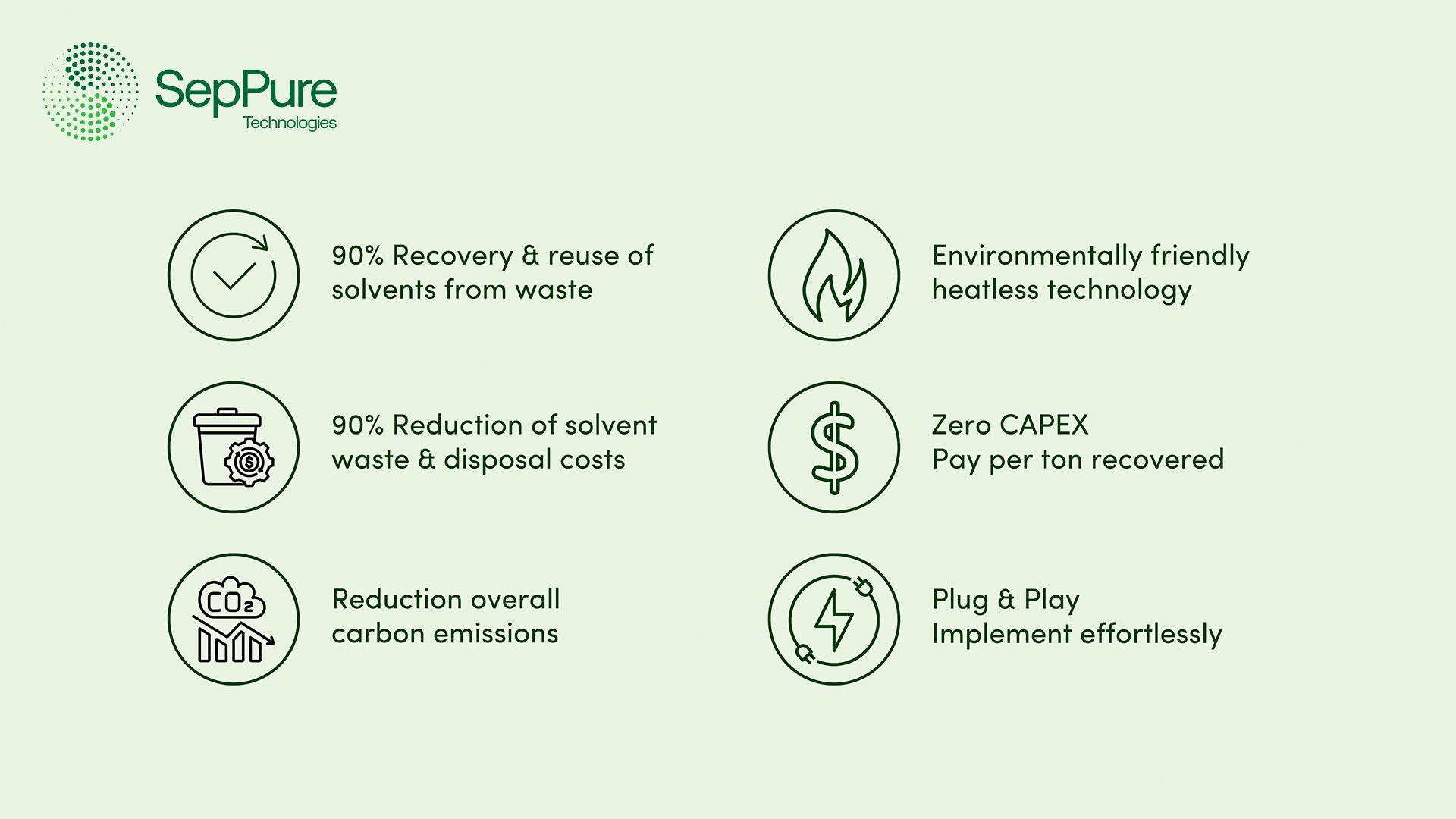
1. 90% Recovery & Reuse of Solvents
SepPure’s advanced nanofiltration technology enables the recovery and reuse of 90% of spent solvents, achieving technical-grade purity exceeding 99.9%. This enables the solvents to be cascaded into other processes and industries, significantly reducing environmental impact compared to using fresh solvents.
2. 90% Reduction of Solvent Waste & Disposal Costs
By significantly reducing the volume of waste solvents, SepPure minimizes disposal costs and lowers the environmental challenges associated with waste management.
3. 90% reduction in energy consumption
By taking on the heavy lifting of bulk solvent recovery, SepPure makes subsequent polishing steps in the semiconductor manufacturing process up to 90% less energy intensive, making the overall process greener.
4. Reducing Overall GHG Emissions
By eliminating the need to incinerate solvents and reducing reliance on energy-intensive processes for chemical separation, such as distillation, SepPure’s solution cuts greenhouse gas emissions, contributing to more sustainable industrial processes.
5. Environmentally Friendly Heatless Technology
Unlike traditional methods that rely on heat, SepPure’s solution is pressure-driven. This not only saves substantial energy, but it also prevents thermal degradation of solvents.
6. Zero-CAPEX Model
SepPure offers a cost-effective, zero-CAPEX model, allowing industries to adopt its solvent recovery technology without significant upfront investment, making sustainability accessible and profitable.
7. Easy Plug & Play System
SepPure streamlines solvent recovery by offering a user-friendly approach: simply fill the system with waste solvent, press a button to start the purification process, and retrieve the high-purity solvent, ready for reuse.
SepPure’s Advanced Membrane Technology Enables Sustainable Filtration for Semiconductors
SepPure’s RE(SOLV)® Solvent Recovery System represents a breakthrough, standing as the most advanced solvent recycling technology in the market. Engineered to be chemically resistant, it withstands a wide range of solvents, ensuring efficient and reliable treatment of even the most chemically challenging substances.
| Feature | SepPure's Technology | Other Solutions |
|---|---|---|
| Module Design | Hollow Fiber Module | Varies, Including Spiral Wound, Flat Sheet, Hollow Fiber, and Tubular |
| Packing Density | High (5X Higher Surface Area) | Low |
| Chemical Resistance | High (e.g., Immersion in DMAc) | Varies with Often Low Resistance |
| Efficiency | High | Moderate |
| Scalability | Excellent (Suitable for Industrial Scale) | Limited |
| Durability | High (Engineered for Harsh Conditions) | Moderate |
This makes SepPure's solutions particularly attractive for semiconductor manufacturers seeking to enhance process sustainability.
Discover Our Products
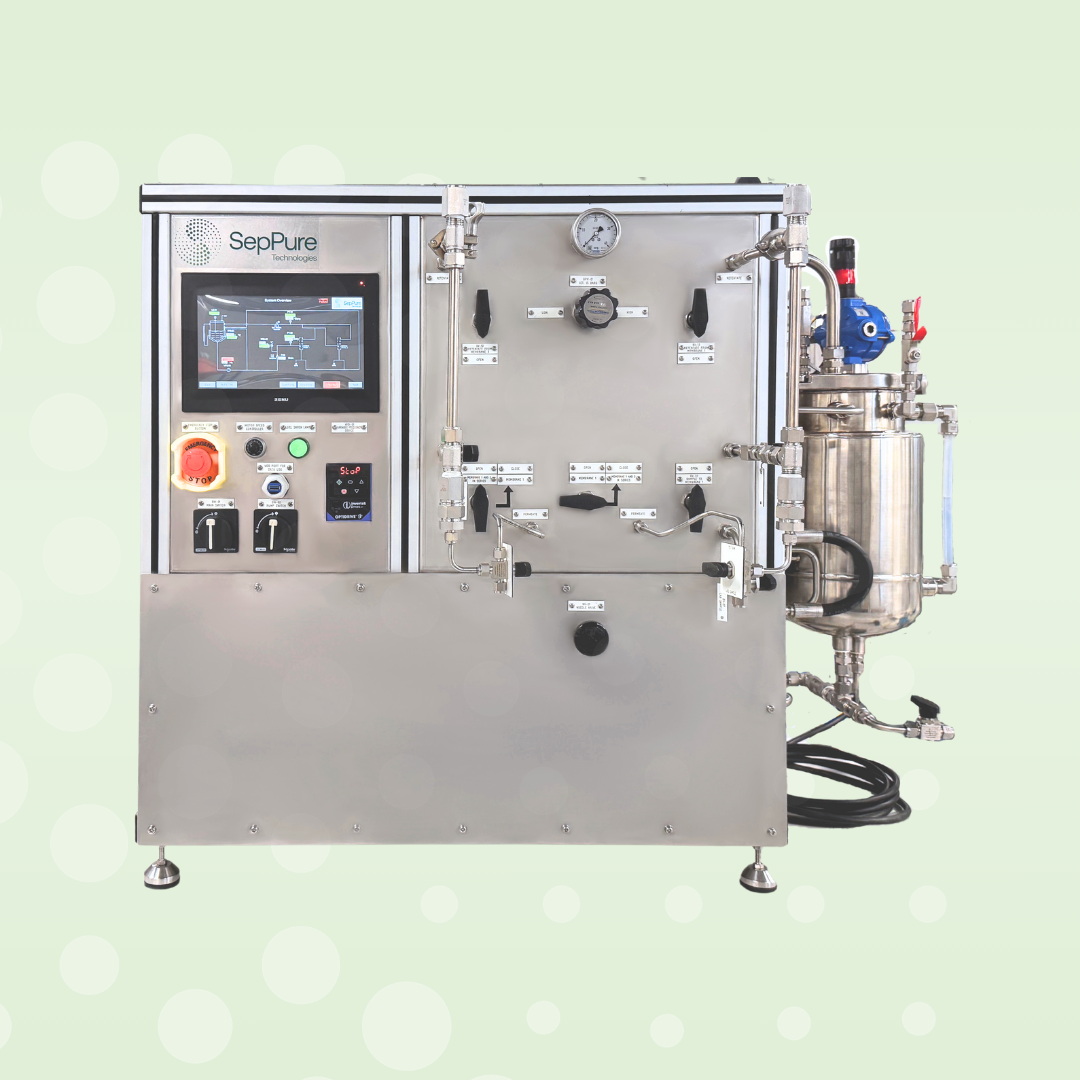
GreenMem® Lab Scale Filtration Unit
The GreenMem® Lab-Scale Filtration Unit is designed for high-precision, efficient crossflow filtration in organic solvent nanofiltration (OSN) applications.
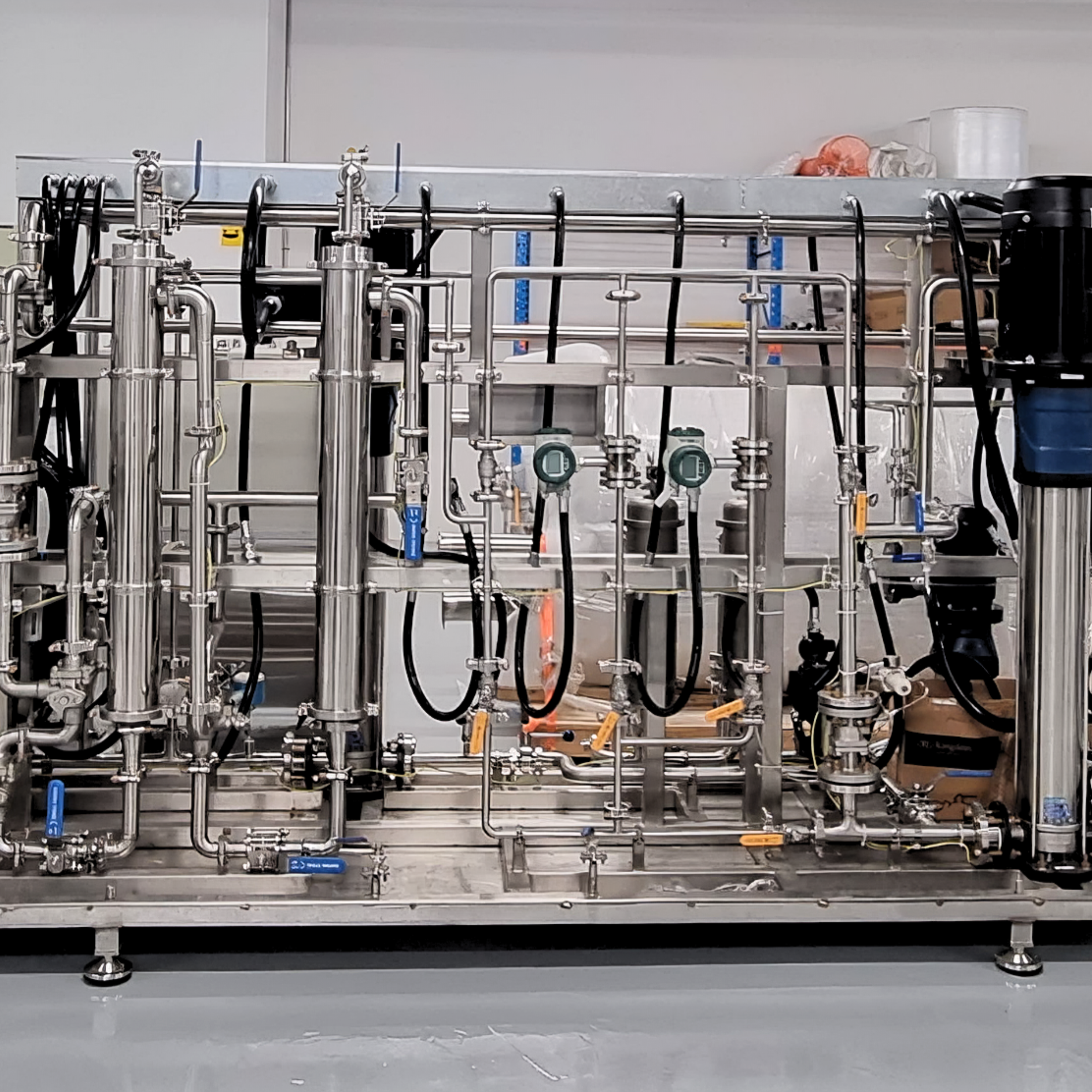
RE(SOLV)® Solvent Recovery System
This system utilizes our propriety GreenMem® membrane technology to effectively filter solvents through a pressure-driven, heatless process.
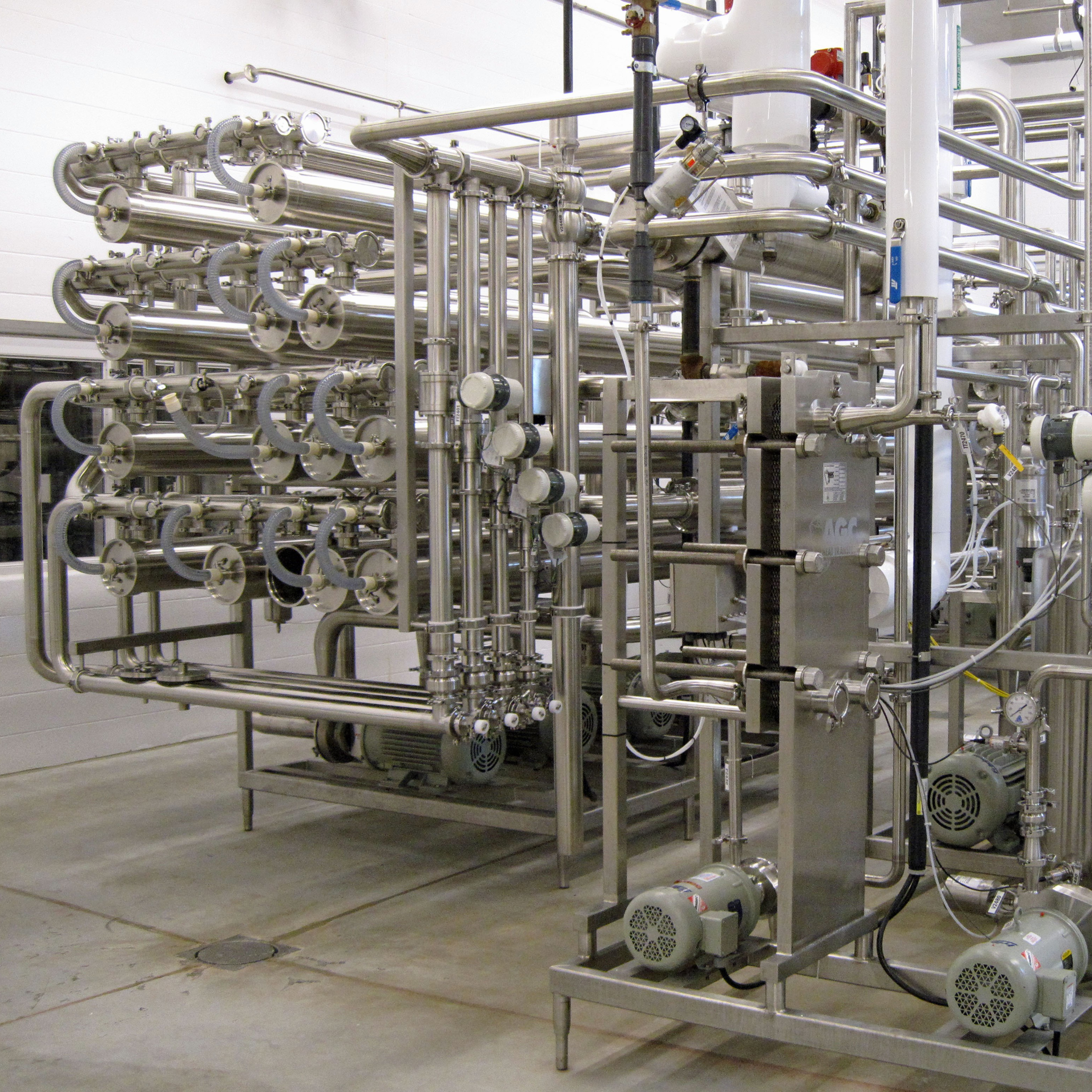
Custom Semiconductor Filtration Solutions
Custom membrane solutions engineered to address your specific semiconductor filtration, purification, and chemical processing requirements.
Interested to learn more?
Frequently Asked Questions (FAQs) About SepPure’s Solvent Recycling for Semiconductor Filtration
-
Semiconductor filtration is a highly specialized process of purifying gases, liquids, and materials used throughout the semiconductor manufacturing process to prevent contamination.
-
Organic Solvent Nanofiltration (OSN) membrane technology uses pressure-driven membranes to separate molecules based on their size and other chemical properties without relying on heat-intensive evaporation.
-
Solvents are of vital importance in the semiconductor manufacturing process, serving as chemical carriers, cleaners, and processing agents to ensure the precision and reliability of microelectronic components. They enable the dissolution and deposition of materials, control reaction conditions, and remove impurities that could compromise circuit performance. Their role is particularly crucial in achieving the accuracy required for advanced chip production, where even the slightest contamination can lead to defects.
-
Some of the primary challenges associated with solvent use in the semiconductor industry include high cost of procuring ultra-pure solvents, substantial solvent use, significant waste generation due to strict contamination tolerance, and improper disposal of waste solvents, all of which lead to increasing environmental and economic concerns.
-
SepPure Technologies enables sustainable recovery of solvents with purity levels exceeding 99.9%. This approach not only makes the subsequent polishing steps less energy intensive, but it allows the solvents to be cascaded into other processes and industries, significantly reducing environmental impact compared to the use of fresh solvents.
-
The semiconductor industry heavily relies on solvents in nearly every stage of the manufacturing processes. However, due to extremely high purity requirements, most solvents are disposed after a single use through incineration. SepPure enables the sustainable recovery of these solvents, allowing them to be reintegrated into the same or other industrial processes.
-
By adapting SepPure’s solution, semiconductor manufacturers can reduce the cost of raw materials and waste management by up to 90%, thereby lowering the overall operational cost of the manufacturing process.
-
SepPure’s solvent recovery solution is powered by the advanced technology of its revolutionary GreenMem® Organic Solvent Nanofiltration membrane. These chemical-resistant hollow fiber membranes feature pores smaller than 1 nanometer in size, thereby allowing very precise separation of chemicals at the molecular level.
-
The traditional solvent recovery methods, such as distillation, are extremely energy intensive. SepPure's innovative heatless technology offers an environmentally-friendly approach compared to conventional models, making it both energy-efficient and cost-effective.
-
SepPure Technologies is the only company in the world that specializes in Organic Solvent Nanofiltration (OSN) membrane solutions for polar and polar-aprotic solvents. Given that the semiconductor industry relies on a variety of solvents, including toxic chemicals, SepPure offers the best and most robust chemical-resistant OSN membranes for this industry in the market.
-
SepPure offers a zero-CAPEX model, allowing businesses to pay based on the tonnage of solvent recovered. This eliminates the need for significant upfront investment, enabling seamless implementation.
-
SepPure streamlines solvent recovery by offering a user-friendly approach: simply fill the system with waste solvent, press a button to start the purification process, and retrieve the high-purity solvent, ready for reuse.
-
Yes, SepPure offers comprehensive support, including technical assistance, system maintenance, and optimization guidance to ensure peak performance and maximum efficiency.