
Sustainable Separation Solutions for Specialty Chemicals
Specialty chemicals represent one of the most diverse and highly specialized segments of the chemical industry, alongside commodity and fine chemicals. They span a wide range of applications, including coatings, polymers, adhesives, surfactants, electronics, agriculture, construction, personal care, advanced materials, and many others. While commodity chemicals are primarily differentiated by scale, availability, and cost, and fine chemicals by purity and precise chemical composition, specialty chemicals derive their value from the specific performance and functionality they deliver in a particular application. They can be produced at volumes ranging from thousands to hundreds of thousands of tonnes per year. Yet, even small variations in purity, composition, or physical properties can affect product performance and the quality of downstream products. Their production therefore often involves complex, multi-step processes with tightly controlled operating conditions and specifications tailored to particular applications.
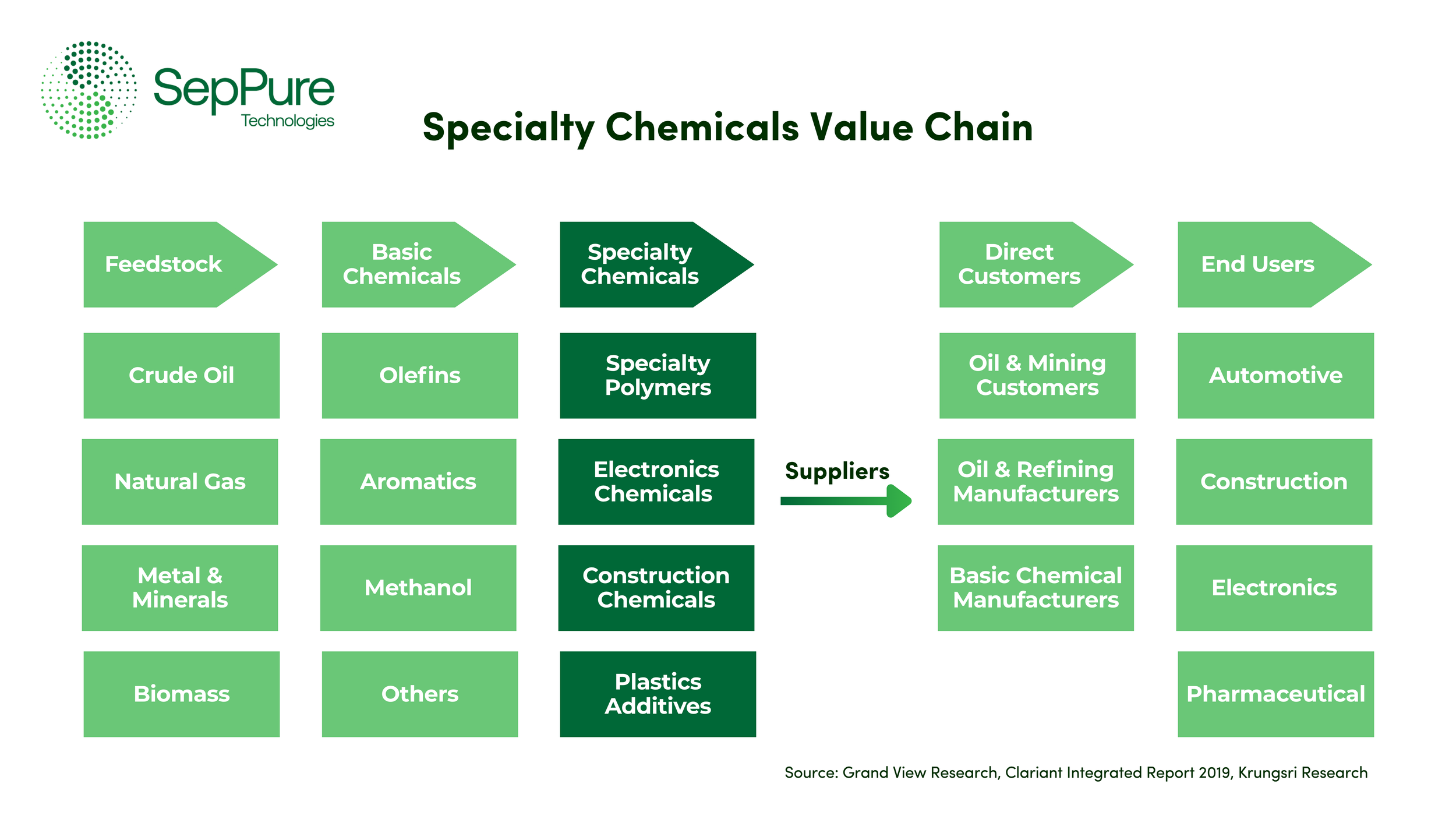
The industry can broadly be viewed as an interconnected value chain spanning upstream, midstream, and downstream activities. Upstream processes provide foundational materials and specialized inputs, such as advanced polymers, resins, and high-purity gases; midstream activities transform these inputs into functional products such as coatings, adhesives, catalysts, additives, and process chemicals; and downstream activities tailor specialty chemicals to specific applications and end markets, including agriculture, electronics, cosmetics, and consumer products. These stages are closely linked, with materials and technologies flowing between them to create increasingly application-specific solutions. Specialty chemicals producers therefore serve a diverse network of industrial customers, from chemical and oil and refining companies to manufacturers across specialized sectors, with their products ultimately supporting end-user industries such as automotive, construction, electronics, pharmaceuticals, agriculture, and consumer goods. Ultimately, the specialty chemicals industry is defined less by the volume of chemicals produced than by the specific application and performance of the final products.
What Are Specialty Chemicals
Specialty chemicals are chemical products engineered to deliver specific functions, performance characteristics, or technical properties for defined applications. They are typically produced in smaller volumes and are differentiated by their application-specific performance, functional properties, and technical requirements. Their development and production often involve specialized formulation expertise and precise control of chemical and physical properties to meet the requirements of specific end-use applications.
The diversity of specialty chemicals reflects the broad range of specific functions and performance requirements they are designed to address. Rather than serving a single purpose, they are developed to deliver specific properties, improve processing and efficiency, enhance product performance, or provide specialized functionality for particular applications. This makes specialty chemicals an important component across a broad range of products and processes. Some of the key areas where they play an important role include:
| Application Area | Description |
|---|---|
| Agro Surfactants & Emulsifiers | In agriculture, specialty surfactants and emulsifiers enhance the effectiveness of pesticides and herbicides by improving their distribution, adhesion, and absorption on plant surfaces. They also improve formulation stability and application efficiency. |
| Textile Specialties | Textile specialty chemicals are used in dyeing, printing, and finishing to enhance fabric performance, appearance, and durability, including properties such as color fastness, wrinkle resistance, softness, stain repellency, and more. |
| Cosmetic Ingredients | Specialty chemicals such as emollients, surfactants, emulsifiers, preservatives, and active ingredients contribute to the safety, stability, efficacy, texture, and sensory properties of cosmetic and personal care formulations. |
| Paints & Coating Additives | Specialty additives improve paint and coating properties such as durability, gloss, adhesion, dispersion, and resistance to environmental factors, enabling performance suited to specific surfaces and conditions. |
| Defoamers & Silicones | Defoamers control unwanted foam in industrial processes, while silicones provide properties such as lubrication, waterproofing, sealing, flexibility, and thermal and chemical resistance. |
| Water Treatment Chemicals | Specialty chemicals such as coagulants, flocculants, scale inhibitors, and corrosion inhibitors support contaminant removal, deposit control, and efficient water and wastewater treatment. |
| Oil & Gas Chemicals | Specialty chemicals address specific oil and gas production and processing requirements, including corrosion inhibition, scale control, demulsification, flow assurance, and separation, helping maintain efficiency and protect equipment. Therefore, specialty chemicals for oil & gas need to meet demanding performance requirements across complex operating conditions. |
| Electronics & Semiconductor Chemicals | High-purity specialty chemicals are used in electronics and semiconductor manufacturing for processes such as cleaning, etching, surface treatment, and more. Their precise properties and high purity support manufacturing consistency, device performance, and product quality. |
As industries continue to pursue higher performance, improved resource efficiency, and more sustainable production, demand for specialty chemicals is expected to increase. The global specialty chemicals market was valued at USD 650 billion in 2023, and it is projected to grow to USD 900 billion by 2030, exhibiting a compound annual growth rate (CAGR) of 5.00%. This continued market growth reflects the expanding role of specialty chemicals across sectors, while growing sustainability priorities are driving the development of solutions that enable more efficient resource use, reduce waste, and minimize environmental impact.
Specialty Chemicals Manufacturing & Environmental Concerns
Specialty chemicals manufacturing prioritizes flexibility, batch precision, and product customization rather than production volume. Most specialty chemicals are produced through batch processing, in which defined quantities of raw materials are combined and processed under controlled conditions. Depending on the product, manufacturing may involve mixing, heating, cooling, chemical reactions, and downstream operations such as distillation, crystallization, filtration, separation, drying, and packaging. Each stage is carefully controlled, and the finished product undergoes quality testing to ensure it meets the required specifications for purity, performance, and consistency.
While batch processing provides the flexibility required to produce a diverse range of specialized products, the complexity of these processes can also increase their environmental footprint. Specialty chemicals manufacturing often involves the use of solvents, reagents, and other process materials, generating waste streams that may require treatment or disposal. Energy-intensive operations, particularly thermal separation processes such as distillation, can further contribute to energy consumption and greenhouse gas emissions. Solvent use and recovery are also important considerations, as solvents can represent a significant share of the materials used in chemical production and may be lost as waste if they are not effectively recovered and reused.
As manufacturers face increasing pressure to reduce emissions, waste, energy consumption, and raw material use, improving process efficiency has become an important part of making specialty chemicals production more sustainable. This includes optimizing production processes, recovering and reusing solvents and other valuable materials, reducing waste, and adopting more energy-efficient separation and purification technologies. Among these, advances in separation technologies are particularly relevant because they can address both the resource intensity of manufacturing and the recovery of valuable materials within the process.
The Shift Toward Sustainable Specialty Chemicals Manufacturing
Specialty chemicals manufacturing is often resource- and energy-intensive, highlighting the complexity of its production processes and the high purity requirements of its products. Production typically involves multiple stages of extraction, concentration, purification, and solvent recovery, often requiring substantial quantities of raw materials, organic solvents, water, and energy relative to the relatively small volumes of high-value products produced. Many of these downstream operations rely heavily on thermal separation processes, such as distillation, which requires significant energy to heat process streams and drive repeated cycles of vaporisation and condensation. This energy demand can be particularly pronounced in specialty chemicals production, where small quantities of valuable compounds must often be recovered at high purity from complex mixtures containing solvents, intermediates, by-products, and impurities. At the same time, extensive solvent and material use increases the overall resource footprint of production, creating a need for more efficient approaches to separation and recovery.
Membrane technologies offer an opportunity to address these challenges by enabling selective separation without requiring a phase change. Given how chemical filtration works and the extensive use of extraction, concentration, purification, and solvent recovery across specialty chemicals manufacturing, membranes can be integrated at multiple stages throughout the process to recover valuable compounds, remove impurities, concentrate products, recycle solvents, and more. By reducing reliance on energy-intensive thermal separations while enabling the recovery and reuse of valuable process materials, membrane-based separation technologies can contribute to more resource- and energy-efficient specialty chemicals manufacturing.
Leverage SepPure’s GreenMem® Nanofiltration Technology for Specialty Chemicals
SepPure’s GreenMem® nanofiltration membranes provide a practical approach to improving separation and recovery processes in specialty chemicals manufacturing. Designed for challenging chemical environments, GreenMem® enables selective separation and purification of chemicals, allowing manufacturers to recover and reuse materials that would otherwise be lost or require energy-intensive processing. This makes the technology particularly relevant for applications involving solvent recovery, product concentration, purification, and removal of unwanted components, providing specialty chemicals filtration solutions for demanding industrial processes.
By integrating GreenMem® into existing process streams, specialty chemicals manufacturers can reduce their reliance on conventional thermal separation methods while improving the recovery of valuable materials. The technology can help lower energy and solvent consumption, reduce waste, and improve overall process efficiency without compromising the purity requirements of high-value specialty chemicals. As manufacturers look for practical ways to make production more resource-efficient, GreenMem® offers a membrane-based solution that can be integrated into a range of processes, including specialty chemicals for oil & gas, specialty chemicals for pharmaceutical applications, and more.
Industries We Empower


And Many More!
What Makes GreenMem® Different?
Engineered for Harsh Conditions: With excellent chemical resistance, GreenMem® membranes maintain reliable separation performance in processes involving harsh chemicals, making them well-suited for demanding industrial applications.
Efficient Solvent Recovery: Recover and reuse valuable solvents efficiently to maximize product yield, reduce solvent consumption, and lower operating costs.
Lower Energy Consumption: GreenMem® membranes deliver high separation performance with significantly lower energy requirements than conventional thermal separation processes. This can help reduce operating costs while supporting a lower carbon footprint across industrial processes.
Scalable & Space-Saving Design: GreenMem® offers a modular, hollow-fiber configuration that provides a high membrane surface area and allows for seamless integration based on specific process requirements.
Proven Applications: From wax and lipid removal in oil processing to API purification in pharmaceutical manufacturing, GreenMem® provides versatile membrane-based solutions for a range of specialty chemicals separation and purification processes.
With its combination of chemical resistance, energy efficiency, and scalable design, GreenMem® provides a practical solution for demanding separation processes across the specialty chemicals industry. Partner with SepPure Technologies to enhance your specialty chemicals manufacturing processes!
Frequently Asked Questions (FAQs) About Specialty Chemicals
-
Specialty chemicals are used in applications where specific performance characteristics are required, such as corrosion resistance, high purity, enhanced durability, or improved process performance. They are widely used across industries including pharmaceutical, petrochemical, semiconductor, and more.
-
Specialty chemicals are typically produced in smaller volumes and formulated for specific applications or performance requirements. In contrast, bulk chemicals are generally manufactured in large quantities for broader, standardized uses.
-
Chemical filtration involves separating unwanted impurities, contaminants, or compounds from a chemical stream to obtain a product that meets particular specification. Depending on the application, this can involve different methods such as physical filtration, adsorption, centrifugation, distillation, extraction, or membrane-based separation. The appropriate method depends on the properties of the chemicals being separated and the desired process outcome.
-
Choosing the right specialty chemicals supplier is important because the quality and consistency of the chemicals used can directly affect process performance, product quality, and overall production costs. A reliable supplier should be able to meet specific requirements for chemical compatibility, purity, performance, and regulatory compliance, while providing consistent quality and dependable supply. The right supplier can therefore help reduce process variability, avoid costly disruptions, and ensure that the chemicals perform as intended in their specific application.
-
Yes. GreenMem®️ Organic Solvent Nanofiltration (OSN) technology can support a broad range of specialty chemicals applications where precise molecular separation, chemical compatibility, and process efficiency are important. Its resistance to challenging organic solvents and ability to separate chemicals at the molecular level make it suitable for demanding chemical processing requirements. GreenMem®️ can also be integrated into existing processes to improve separation efficiency while reducing energy consumption compared with conventional thermal methods.