
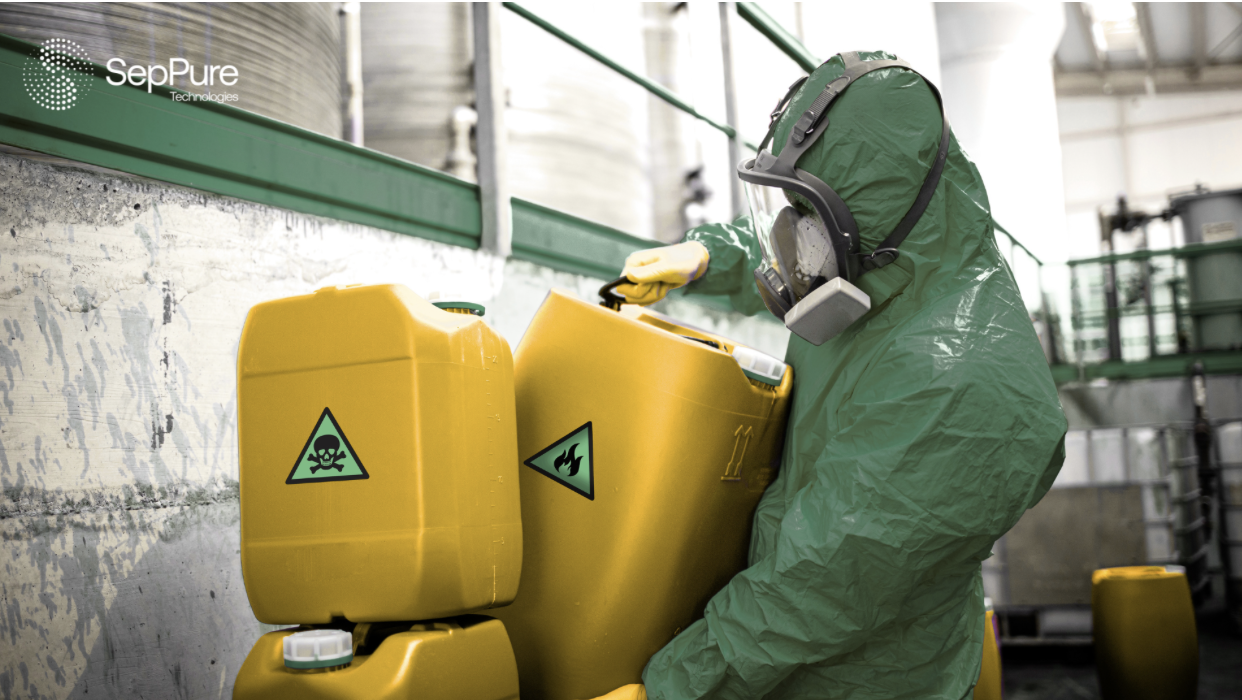
Most chemical plants can tell you, to the litre, how much solvent they buy. Far fewer can tell you what it costs to get rid of it afterwards. That gap is where the economics of solvent waste management quietly go wrong.
Membrane researchers who work with organic media describe a remarkably consistent pattern. A solvent enters a process as a clean, purchased raw material, does its job as a reaction medium, extractant or wash, and leaves as solvent waste: a liquid that is still, for the most part, perfectly good solvent, carrying a small amount of dissolved material. Traditional solvent waste disposal treats that whole stream as a liability. A more modern view treats it as a separation problem, and separation problems are exactly what membranes are built to solve.
How big is the solvent waste problem?
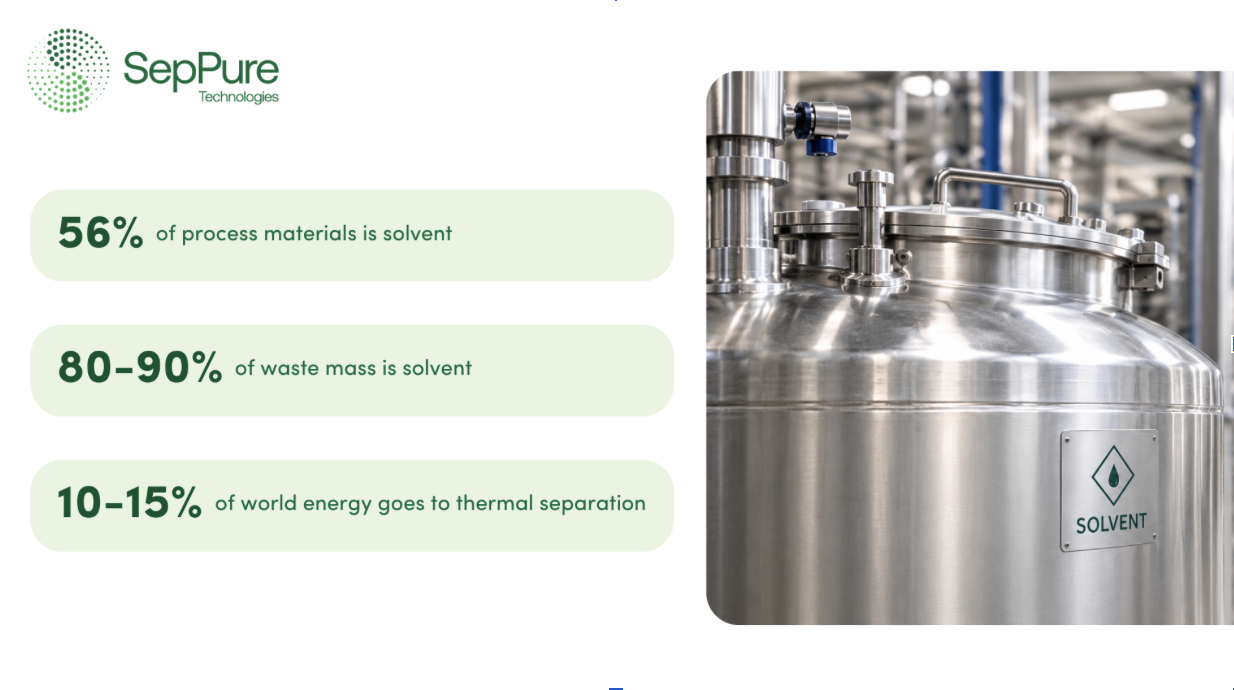
Solvents are the quiet majority of what goes into a chemical process. In the pharmaceutical sector, benchmarking by the ACS Green Chemistry Institute Pharmaceutical Roundtable found that organic solvents account for an average of 56% of the material used in a process, with water making up a further 32%. The same body of work has led to estimates that solvents contribute 80–90% of the mass of waste streams in pharmaceutical manufacturing. In other words, when a plant talks about solvent waste, it is talking about the bulk of its waste.
The energy dimension is just as striking. Sholl and Lively’s widely cited analysis in Nature noted that thermal separation processes such as distillation account for 10–15% of the world’s energy consumption, and Georgia Tech, summarising the work, observed that chemical separations account for about half of all US industrial energy use. Solvent purification is only one slice of that picture, but it is a slice that sits inside nearly every pharmaceutical, specialty chemical, petrochemical and semiconductor facility.
For membrane technologists, the more interesting point lies elsewhere. The same Nature analysis points out that membrane-based and other non-thermal separations can be an order of magnitude more energy efficient than heat-driven distillation, yet comparatively little research had gone into them. That gap between potential and practice is exactly where modern solvent waste solutions are being built.
Why solvent waste disposal is under pressure
Three forces are pushing against the traditional habit of using a solvent once and then sending it away.
Regulation. In the United States, spent solvents from common industrial uses are listed as hazardous waste on the EPA’s F-list in 40 CFR §261.31. The listing also captures still bottoms from the recovery of these spent solvents, which means the residue left after thermal recovery can remain a regulated stream in its own right.
Policy. In Europe, the Waste Framework Directive sets a five-step waste hierarchy: prevention, re-use, recycling, recovery (including energy recovery) and safe disposal as a last resort. Energy-efficient incineration can be classed as recovery under the Directive, but it still ranks below re-use and recycling. For solvent waste disposal, the direction of travel is clear: the preferred outcome is keeping the solvent in circulation.
Economics. Every litre of solvent waste sent for incineration is a litre that was bought, transported and treated, and a litre that must be bought again. Disposal costs, replacement purchasing and compliance effort compound one another, and they rise as regulation tightens. Because these costs are spread across several budget lines, they are rarely seen as one problem, which is partly why the linear model persists.
From solvent waste disposal to solvent waste solutions
Process engineers who take a fresh look at solvent waste management often start with a deceptively simple question: what is actually in the waste solvent? Usually the answer is that it is mostly clean solvent carrying a modest load of dissolved by-products, catalyst, API residue or oils. Disposal treats the entire stream as waste because it is mixed. Recovery treats it as a separation challenge, and once it is framed that way, the options open up.
The circular approach has a simple logic. Spent solvent goes into a recovery step, the purified solvent returns to the process or is cascaded into a less demanding secondary application, and only the concentrated residue leaves as true waste. The result is less fresh solvent bought, fewer tonnes sent for disposal, and a stream that moves from being a recurring expense to a recovered asset.
Distillation has been the default tool for this for generations, and it works. But it is heat-driven: it needs energy to vaporise the solvent, it can stress thermally sensitive molecules, and it struggles when boiling points are close or azeotropes form. That is the opening for pressure-driven separation.
Where OSN-based solvent waste solutions deliver
The same membrane platform serves very different industries because the underlying problem, separating small solvent molecules from larger dissolved ones, is common to all of them.
Pharmaceutical: solvent exchange, catalyst recovery, and API concentration and purification, with lower solvent consumption, less waste and lower energy demand.
Petrochemical: recovery of valuable solvents at scale, with hydrocarbon separations and product upgrading as related applications.
Semiconductor: energy-efficient recovery of more than 90% of spent solvent, either for reuse within the operation or for cascading into secondary industrial uses.
Specialty chemicals: non-thermal catalyst recovery, gentle concentration of heat-sensitive compounds and monomer removal.
Edible oils: removal of free fatty acids, waxes and lipids during refining, where non-thermal operation is attractive.
In each case the benefit is the same in kind: less fresh solvent purchased, less solvent waste leaving the site, and lower energy use per unit of solvent processed.
A practical framework for solvent waste management
For a plant starting from scratch, a sensible sequence looks like this.
Characterise the stream. Identify the solvent, the dissolved solutes and their molecular weights, water content, temperature and any particulates.
Place it on the hierarchy. Ask whether the solvent can be prevented, re-used or recycled before any disposal route is considered.
Test at lab scale. Generate real flux and rejection data on the plant’s own waste solvent rather than relying on model compounds.
Pilot on the real stream. Confirm stability, fouling behaviour and cleaning requirements over extended operation.
Integrate and measure. Track recovery percentage, recovered solvent purity, energy use, avoided solvent purchases and reduced disposal volumes, so the business case is visible.
Solvent waste has long been treated as the inevitable cost of making things. The science and the regulatory direction both say otherwise. The most effective solvent waste solutions keep the solvent in the loop, use energy only where it is truly needed, and turn a recurring disposal expense into a recovered resource.
SepPure’s Organic solvent nanofiltration offers a heatless, compact and increasingly proven route from solvent waste disposal to solvent recovery. The practical advice from specialists is simple: pick one solvent stream, characterise it properly and test it, because measured data on a real stream is more persuasive than any specification sheet.